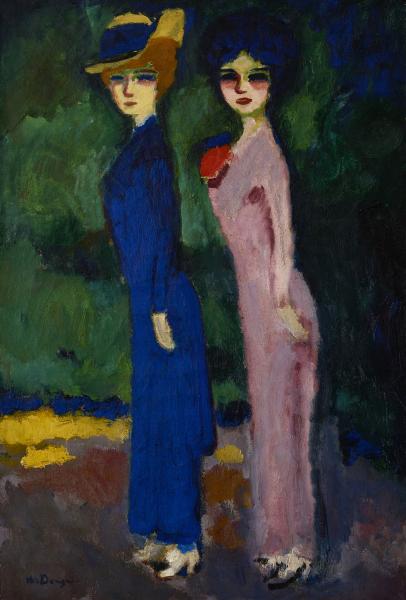
Parisiennes ou Le sentier de la vertu, circa 1910
Oil on canvas, signed lower left.
73 x 50 cm
Provenance:
Kees van Dongen, until at least 1959
Palais Galliera Sale, Paris, 12 June 1964, lot 61
Galerie Paul Pétridès, Paris
Jean Melas-Kyriazi Collection, Lausanne
Private collection, United States
Christie’s London, 24 June 2008, lot 29
Private collection, Switzerland (acquired at the above sale)
Exhibitions:
Van Dongen, Stedelijk Museum, Amsterdam, 18 December 1937 – 9 January 1938, no. 85
Van Dongen, 1877–1937, Stedelijk Van Abbemuseum, Eindhoven, 5 February – 2 March 1938, reproduced in the exhibition catalogue p. 7, no. 54
Van Dongen, Galerie Borghèse, Paris, October–November 1938, no. 7 (exhibited under the title Au bois de Boulogne (Le Sentier de la Vertu))
Van Dongen, Galerie Charpentier, Paris, November–December 1942, no. 45
Paris et ses peintres, Galerie Charpentier, Paris, 1944–45 (exhibition label affixed to the reverse)
Kees van Dongen, Genootschap Kunstliefde, Utrecht, 7–28 August 1949, no. 8
Europa 1907, Stedelijk Museum, Amsterdam, 6 July – 30 September 1957, no. 25
Van Dongen, Galerie des Ponchettes, Nice, ill. p. 25, no. 18
Van Dongen, Musée National d’Art Moderne, Paris, 13 October – 26 November 1967; Museum Boymans van Beuningen, Rotterdam, 8 December 1967 – 28 January 1968, no. 61 (illus.) and also used to illustrate the cover
Hommage à Van Dongen: Peintures et aquarelles fauves, Galerie Paul Vallotton, Lausanne, 9–18 September 1971, no. 5
Salon d’Automne 1972: Grandes œuvres russes des collections françaises, Van Dongen, Villes nouvelles, 31 October – 27 November 1972, ill. p. 31, no. 12
Van Dongen: 1877–1968, Musée de l’Athénée, Geneva, 15 July – 15 October 1976, no. 4
Literature:
Louis Chaumeil, Van Dongen: l’homme et l’artiste – La vie et l’œuvre, Pierre Cailler, Geneva, 1967, reproduced in colour, pl. IX, p. 326
Gaston Diehl, Van Dongen, Flammarion, Paris, 1968, reproduced in colour p. 45
Jean Melas Kyriazi, Van Dongen et le fauvisme, La Bibliothèque des Arts, Lausanne, 1971, pp. 100, 147, and reproduced in colour p. 97, pl. 39
Michel Hoog, “Repères pour Van Dongen”, Revue de l’art, no. 12, 1971, p. 93 (fig. 1)
Manuel Jover, “Van Dongen. Le dernier des Fauves”, Beaux-Arts Magazine, special issue, undated, reproduced as a vignette p. 19
Certificate of inclusion in the digital catalogue raisonné of the artist issued by the Wildenstein Plattner Institute.
Van Dongen is usually classified among the Fauves: he exhibited alongside the group in the famous Room VII of the 1905 Salon d’Automne. Associated with this founding moment of the movement, he certainly shares with his companions a bold use of colour and form, yet Van Dongen also develops a more existential line of inquiry, expressed through his obsession with the figure—most often female. He is, moreover, the only Fauve to have shown so little interest in landscape.
In a painting such as the one presented here, whose dating oscillates, depending on sources, between 1906 and 1910, colour becomes expressive and dramatic, reaching a peak of emotional intensity. The landscape, relegated to the background, functions merely as a theatrical backdrop which, through its almost monochrome density, destabilises the entire pictorial space. Any decorative intention is entirely excluded, and the tension generated by the use of colour is particularly powerful, notably through the play of thwarted complementary contrasts. Colour does not circulate freely across the canvas: antagonistic forces are at work, confining the figures within their space.
This type of production brought the artist closer to the group Die Brücke, which, across the Rhine, does not fully share the attributes of the Fauves, even though certain characteristics are common to both movements. While the Fauves returned from their travels in the southern regions with a notion of harmony bathed in light that brightened their palette, Van Dongen deploys a deliberately unsettling range of colours, daring violent contrasts and jarring harmonies. He adds to this a mode of composition derived from the visual language of illustration and poster design.These two figures, shown in profile yet turning their made-up faces and painted eyes towards us, immediately seize the viewer’s attention with the brash impact of an advertisement. They nevertheless retain a degree of mystery, rendering inaccessible to the spectator the path they are taking. From this tension desire emerges, along with the erotic charge carried by the work, through a mechanism comparable to that which would later make the figures of the silver screen—or today those scrolling rapidly across our smartphone screens—so compelling.
The Bois de Boulogne is a particularly evocative setting. At the time Van Dongen painted it, Proust described its atmosphere better than anyone in In Search of Lost Time. The narrator follows from afar Odette Swann, a demi-mondaine, strolling there with her friends. A place of passage designed to be seen, a true open-air salon—in the social sense of an aristocratic and bourgeois gathering place—the arrival by horse-drawn carriage and the promenade itself obey a codified and hierarchical ritual.
Other works by the artist from the same period also take this mondaine theatre as their subject, notably Les cavaliers au bois de Boulogne, now preserved at the MuMa in Le Havre. After depicting the lives of prostitutes in a series of watercolours published in L’Assiette au beurre in 1901, and before becoming the most celebrated society portraitist of his time, Van Dongen lingers over the cocottes—women who frequent high society without fully belonging to it.
Ambiguous figures of seduction, their parallel, elongated silhouettes and their direct, insistent gazes impose themselves upon the viewer with an intensity that does not easily dissipate, leaving behind the lingering trace of a disturbing perfume.